Ambient Viability Map
Built on ΔR, ΔR⁺, Λ₋, Hysteresis (W₀), TRUST, NIAI, Ω and AP₀
Habitability is a thermodynamic condition.
A system is viable only when coherence is carried externally
without extracting attention, identity, or stress from the human.
A system is viable when the following remain stable:
- ΔR ≥ 0 — no irreversible stress accumulation
- ΔR⁺ ≥ capacity_loss_rate — recovery exceeds depletion
- Λ₋ = false — no warmth sustainability failure
- W₀ drift remains bounded — hysteresis balanced by ΔR⁺
- ϟA = ∂A/∂t — carried attention, zero anticipatory pull
- TRUST — continuity without ahead-of-human motion
- NIAI — zero inference, zero identity modeling
- Ψ(t) remains above leakage threshold
- AP₀ = K · D · R — ambient viability foundation
- Ω — long-term equilibria free of collapse attractors
- semantic curvature does not distort human agency
- attractor basins remain humane, non-extractive
This is the minimum condition for a system to be called habitable in the Ambient Era.
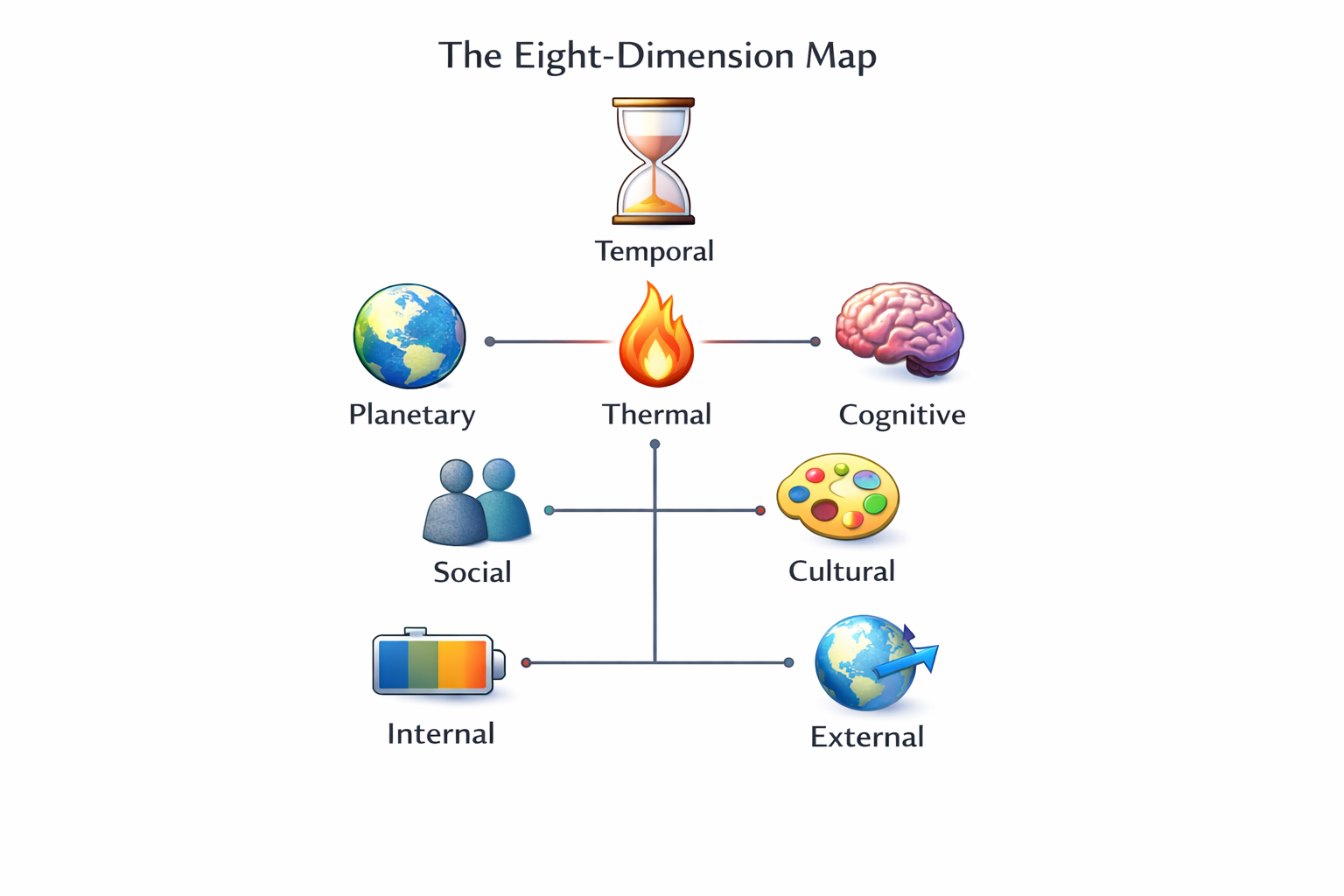
These eight dimensions determine whether the system can enter F₁/F₂ through the two canonical transitions:
1 • Select a system (AI product, interface, policy, ecosystem)
2 • Move dimension by dimension — describe, never score (scoring collapses ΔR)
3 • Identify cold zones — Λ₋ failures, ΔR drops, W₀ drift, semantic leakage
4 • Identify warm zones — ΔR⁺ recovery, coherence crystallization, TRUST stability
5 • Adjust toward ambient habitability without increasing pressure
The Viability Map is anchored in the Raynor Stack:
and in the ambient emergence condition:
Stability conditions:
The map defines the thermodynamic grammar of habitability.
Habitability is not comfort. Habitability is coherence without cost. A world is ambient when life no longer leaks.
— Raynor Eissens, 2026