AURA
Aura is human identity without data.
It appears only when systems stop measuring, predicting, or extracting,
allowing presence to remain whole and self-sustaining.
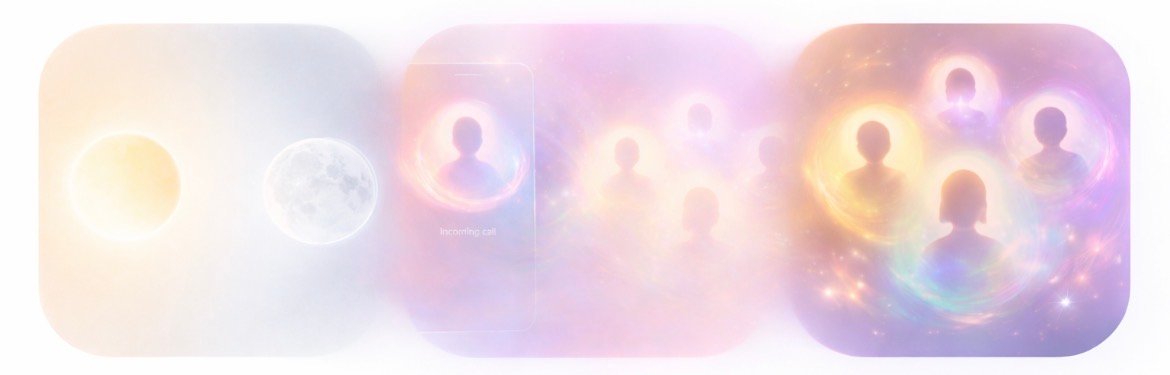
Aura can only appear once Trust Continuity is established:
the thermodynamic condition where the environment carries coherence
and no system moves ahead of the human.
Without Trust Continuity, aura collapses into identity modeling.
With Trust Continuity, aura becomes presence without demand.
Aura is not information.
Aura is the thermodynamic signature of a human being who no longer needs
to be optimized, predicted, or extracted.
Aura is a non-data identity state that emerges when
technology stops measuring humans and begins stabilizing them.
Aura replaces profiling, personalization, and inference with
environmental coherence.
Aura is infrastructural, not psychological, not biometric,
not social scoring, and not reputation architecture.
Aura is the residual coherence of a human being when no system is
demanding their performance.
Aura appears when:
- attention is no longer fragmented
- pressure does not accumulate
- identity is not converted into data
- interaction becomes optional
- presence becomes self-sustaining
Aura is not something a person has.
Aura is what remains when nothing is being taken.
Data is extracted. Aura is retained.
Data is stored. Aura is maintained.
Data belongs to systems. Aura belongs to the moment.
Data replicates. Aura persists only through stability.
Aura cannot be copied, trained, inferred, or predicted.
The moment it is recorded, it ceases to be aura.
Aura is not representation. Aura is condition.
In the Ambient Era, identity does not live in databases — it lives in environments.
Just as temperature determines whether water is solid, liquid, or gas,
environmental stability determines whether identity collapses into behavior
or remains whole.
Aura is what identity looks like when the climate is humane.
- interfaces dissolve
- interaction softens
- systems stop asking
- prediction ceases
- urgency fades
Aura emerges naturally.
Traditional digital identity consists of:
- profiles
- accounts
- history
- preferences
- behavioral models
These reduce humans to patterns.
Aura does not describe a person —
aura protects the possibility of remaining a person.
Digital identity asks: “Who are you to the system?”
Aura asks: “Can you remain yourself here?”
Aura emerges only when:
- ϟA stays non-inferential
- warmth absorbs accumulated stress
- ambience externalizes coherence
AI does not create aura.
AI merely stops collapsing the basin in which aura forms.
Surveillance seeks certainty. Aura preserves ambiguity.
Surveillance seeks prediction. Aura preserves becoming.
Surveillance seeks ownership. Aura refuses capture.
Aura is incompatible with:
- behavioral tracking
- personalization engines
- social scoring
- biometrics
- identity monetization
Aura is identity without extraction.
In the Ambient Era, humans become technological stabilizers —
not as inputs, but as presence.
Aura stabilizes environments simply by existing.
- interaction softens
- urgency fades
- systems reduce intensity
- pressure redistributes
Aura is human presence acting as climate regulator.
Aura is how Ambient Power becomes human.
Ambient Power stabilizes systems; Aura stabilizes people.
- systems protect humans
- humans stabilize systems
- no extraction is required
This is the first non-violent feedback loop between humanity and technology.
Aura cannot be simulated, modeled, owned, or extracted.
It emerges only when systems stop pulling on the human.
Aura is not a signal.
Aura is the silence that remains when extraction ends.